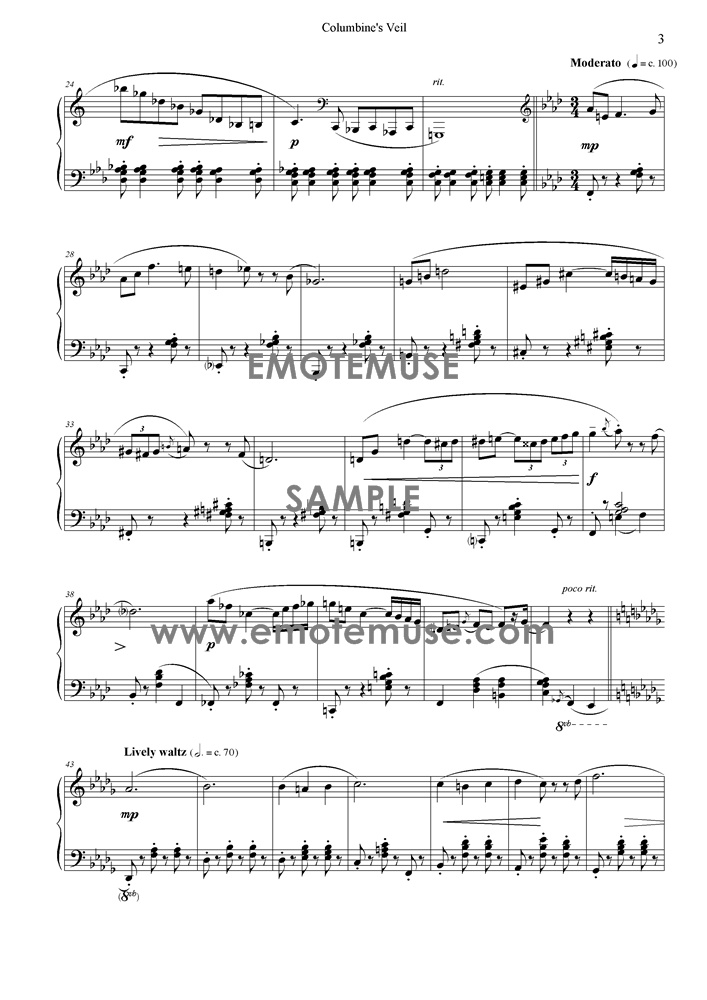
Columbine’s Veil

Title: Columbine’s Veil
Composer: Greg Smith
Instrumentation: Piano
Product medium: PDF score


Background:

Pierrot, separated from his love Columbine, is weeping in his room. Overcome with sorrow, he falls asleep in the corner. Some friends of Pierrot come to visit. When they eventually find him, they fetch a nearby pianist and suggest waking Pierrot with a dance. However, the waltz fails to wake him up. Eventually Pierrot wakes. His friends tease him for sleeping through their “entertainment”, and tease him by seizing a portrait of Columbine. They continue to dance around the room, mocking Pierrot’s misfortune. The friends leave. The pianist, unaware that they had left, continues playing, but is hastily stopped by an ill-tempered Pierrot.

Once again alone, Pierrot contemplates suicide. He fetches a poison potion, but is interrupted by a knock on the door. It is his love Columbine. She is dressed in a wedding dress. Pierrot tears off her veil and his thoughts return to suicide. Columbine is ready to die with him, but only after they have have enjoyed some festivities. Although they enjoy some merry making, Pierrot remembers the goblet and his resolve to die, and sips the goblet. He invites Columbine to take a sip, but she hesitates. Pierrot dies, and Columbine flees.

At Columbine’s parents’ house, the wedding ball is taking place. The dance master announces a quadrille. Having started the music, the dance master notices that Columbine is not present to dance with her partner, Harlequin. The dance master, invites the other company to dance a minuet. Harlequin grows increasingly restless at the disappearance of his newlywed wife. Columbine enters and explains that she was tending to her attire. Harlequin doesn’t believe her. The guests continue to dance their minuet. Seeing that the situation may get out of control, the dance master starts a wild gallop as a distraction from the unrest of the newlyweds. A Moor appears to offer the guests a drink. When Columbine reaches to take a glass, the Moor disappears and sees the ghost of Pierrot holding her wedding veil. Columbine returns to Pierrot’s room to retrieve her veil. Columbine has followed her, and discovers the body of Pierrot. He locks Harlequin in a room with Pierrot’s body as revenge for her infidelity. Trapped and in despair, Harlequin drinks the poison and dies at Pierrot’s feet.
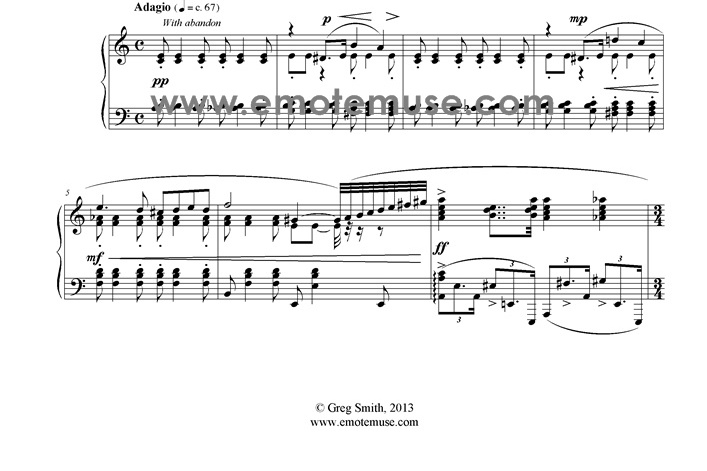
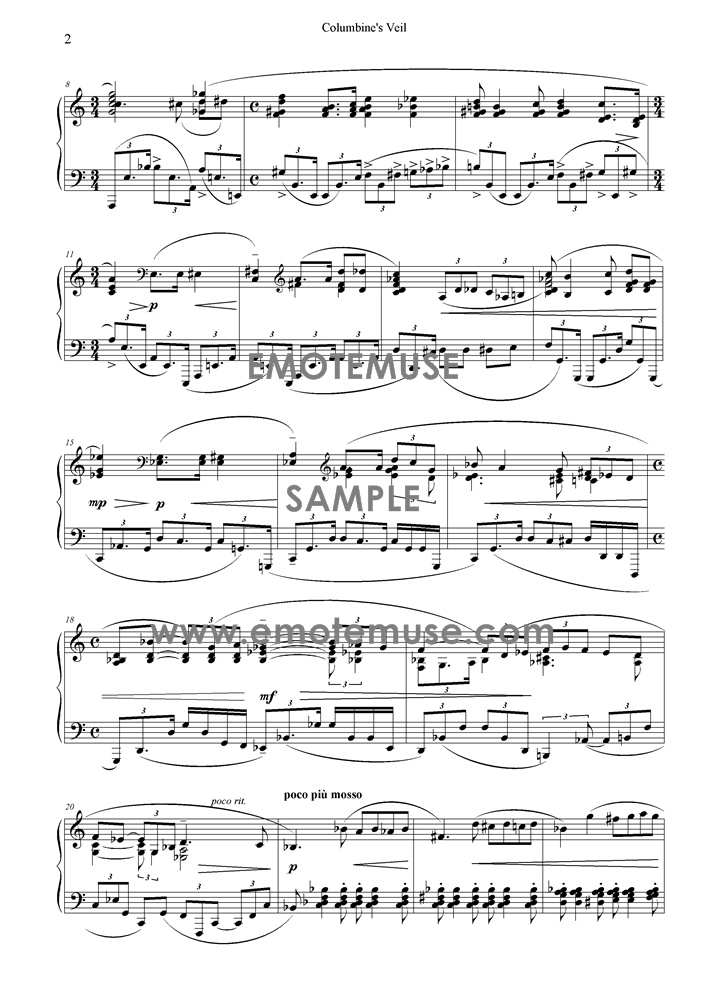
 Columbine's Veil (Greg Smith) - Sample Columbine's Veil (Greg Smith) - Sample Columbine's Veil (Greg Smith) - Sample


Posted

in

by


Featured Content

Pablo Casals’ obligation
“I am a very simple man. I am a man first, an artist second. My first obligation is to the welfare of my fellow man. I will endeavour to meet this obligation through music, since it transcends language, politics and national boundaries.” – Pablo Casals, Spanish cellist. Source: pablocasals.com. Accessed 22 Jan 2013.
I Will Walk in the Presence of the Lord – Psalm 115 (116b), Psalm 114 (116a)
Title: I will walk in the presence of the Lord Text:     – Psalm 115 (116b):10, 15-19 (R. Psalm 114 (116a):9)     – Psalm 114 (116a):1-6, 8-9. R. v.9. Composer: Greg Smith Instrumentation: SATB and piano Product medium: PDF Score and part Sample:
One Week
Title: One Week (silent film soundtrack) Composer: Greg Smith Instrumentation: Piano Product medium: PDF score BACKGROUND: Film:        Directors: Edward F. Cline & Buster Keaton        Starring: Buster Keaton, Joe Roberts, Sybil Seely        Date of release: 1920        Synopsis: A newly wed couple receive a generous […]
The effect of Tchaikovsky’s music on his patroness
Nadyezhda Filaretovna von Meck was Tchaikovsky’s patroness.  In March 1877 she wrote of the effect of Tchaikovsky’s music on her.  The work being described is a Marche Funèbre on a theme from Oprichnik (this work is now lost).    It is so superb that, as I had hoped, it elevates and transports me into a […]
Performance practice issues in Russian Piano Music
ABSTRACT The nineteenth and twentieth centuries witnessed the rapid growth of musical culture in Russia. This resulted in a large repertoire of piano music — ranging from miniatures to virtuosic etudes and sonatas. Growing out of the nineteenth century romantic tradition, and highly influenced by the social conditions of the time, Russian composers developed a distinctive style which […]
Harmann on orchestration
“To orchestrate is like a thumbprint. I can’t understand having someone else do it. It would be like someone putting color to your paintings.” – Bernard Hermann on orchestration. Hall, Roger L., A Guide to Film Music, p. 43.  Cited at Wikipedia.
Rossini and food
“After doing nothing, I know no more delightful occupation of eating, eat properly, I mean. The appetite is for the stomach what love is for the heart. The stomach is the choirmaster who governs and operates a large orchestra of the passions. An empty stomach is the bassoon or flute in which discontent grumbles or […]
Difficult music is the easiest to play
Scriabin’s fiery D#-minor Etude, with its relentless triplets and huge leaps, used to just fall under my fingers, while the Lento final movement of the Copland Sonata was a minefield of wrong notes. Why is that? Is it just because we practice hard music 20 times as much as easy music, or is it psychological, […]
The London Proms in the 1930s
A recollection of the London Proms in 1936: The behavior of the Promenaders was more genteel in those days … there wasn’t the same degree of shouting as now.  During the famous hornpipe in Henry Wood’s Fantasia on British Sea Songs people tapped with their umbrellas and sticks, rather than stamping.  As the applause went […]
Piano