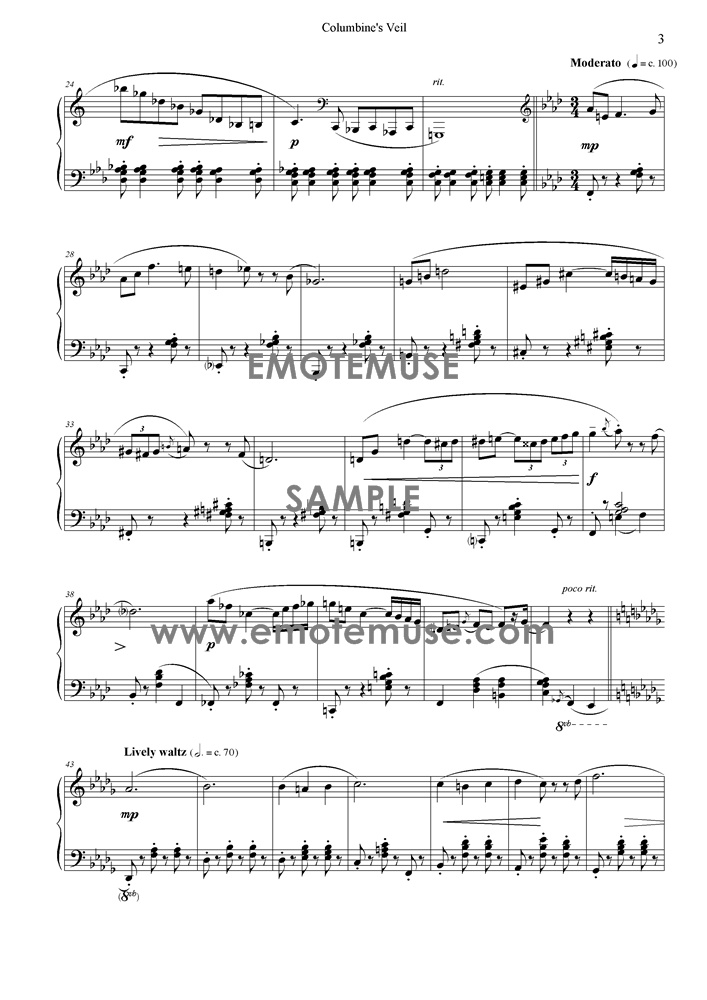
Columbine’s Veil

Title: Columbine’s Veil
Composer: Greg Smith
Instrumentation: Piano
Product medium: PDF score


Background:

Pierrot, separated from his love Columbine, is weeping in his room. Overcome with sorrow, he falls asleep in the corner. Some friends of Pierrot come to visit. When they eventually find him, they fetch a nearby pianist and suggest waking Pierrot with a dance. However, the waltz fails to wake him up. Eventually Pierrot wakes. His friends tease him for sleeping through their “entertainment”, and tease him by seizing a portrait of Columbine. They continue to dance around the room, mocking Pierrot’s misfortune. The friends leave. The pianist, unaware that they had left, continues playing, but is hastily stopped by an ill-tempered Pierrot.

Once again alone, Pierrot contemplates suicide. He fetches a poison potion, but is interrupted by a knock on the door. It is his love Columbine. She is dressed in a wedding dress. Pierrot tears off her veil and his thoughts return to suicide. Columbine is ready to die with him, but only after they have have enjoyed some festivities. Although they enjoy some merry making, Pierrot remembers the goblet and his resolve to die, and sips the goblet. He invites Columbine to take a sip, but she hesitates. Pierrot dies, and Columbine flees.

At Columbine’s parents’ house, the wedding ball is taking place. The dance master announces a quadrille. Having started the music, the dance master notices that Columbine is not present to dance with her partner, Harlequin. The dance master, invites the other company to dance a minuet. Harlequin grows increasingly restless at the disappearance of his newlywed wife. Columbine enters and explains that she was tending to her attire. Harlequin doesn’t believe her. The guests continue to dance their minuet. Seeing that the situation may get out of control, the dance master starts a wild gallop as a distraction from the unrest of the newlyweds. A Moor appears to offer the guests a drink. When Columbine reaches to take a glass, the Moor disappears and sees the ghost of Pierrot holding her wedding veil. Columbine returns to Pierrot’s room to retrieve her veil. Columbine has followed her, and discovers the body of Pierrot. He locks Harlequin in a room with Pierrot’s body as revenge for her infidelity. Trapped and in despair, Harlequin drinks the poison and dies at Pierrot’s feet.
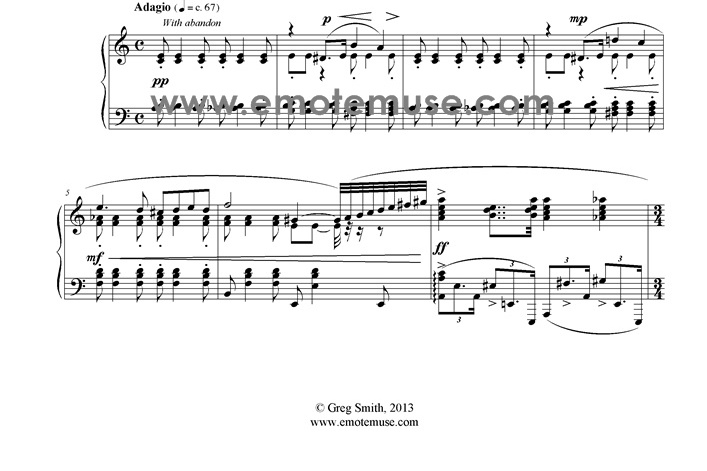
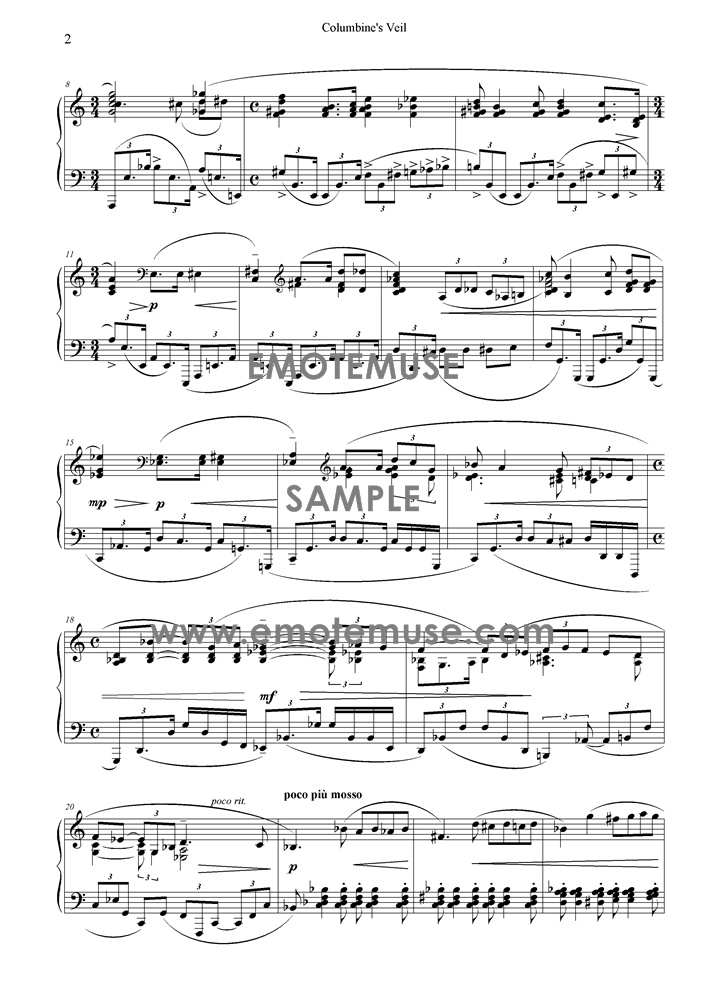
 Columbine's Veil (Greg Smith) - Sample Columbine's Veil (Greg Smith) - Sample Columbine's Veil (Greg Smith) - Sample


Posted

in

by


Featured Content

Kreutzer’s Wanderlieder and Schubert
Schubert was familiar with Kreutzer’s Wanderlieder song cycle (written in 1817). Spaun twice told the following anecdote of his friend’s reaction to the Wander-Lieder shortly after their publication: “We once found him playing through Kreutzer’s Wanderlieder, which had just appeared. One of his friends [ Anselm Hüttenbrenner] said ‘Leave that stuff alone and sing us […]
True greatness
Life is made up of little things. It is very rarely that an occasion is offered for doing a great deal at once. True greatness consists in being great in little things. – Charles Simmons (1852) A Laconic Manual and Brief Remarker: Containing Over a Thousand Subjects.  North Wrentham: Charles Simmons, p. 315.  Digitally archived […]
Brahms’ harmonic exercise
It was during the summer of 1858 that Brahms met Agathe von Seibold.  He had gone to visit Ise Grimm at Göttingenm the university town where Joachim spent his holidays.  Ise had recently married, and his home was a meeting place for the younger musicians. I have invited some people in this evening,” he told […]
Look under your feet
The lesson which life constantly repeats is to ‘look under your feet.’You are always nearer to the divine and the true sources of your power than you think.The lure of the distant and the difficult is deceptive.The great opportunity is where you are.Do not despise your own place and hour.Every place is under the stars.Every […]
Violoncello piccolo
A violoncello piccolo is a violin-sized instrument tuned like a cello.  It is held horizontally, slung from a from a strap over the shoulder lika guitar.  Some of Bach’s cantatas specifically written for this instrument.  It is possible that Bach wrote the cello suites for the instruments (no instrument was specified on the manuscripts). Source: […]
Music and identity
“The more anonymous music is, the less likely people will be to feel attached it and to feel the need to support it. But when someone knows who you are, when you’re not just some disembodied vibrations in the air, they’re far more likely to stand behind you.” Isaac Schankler. “Beyond Sound and Science: Musicians, […]
Stravinsky on composition
“For me, as a creative musician, composition is a daily function that I am compelled to discharge. I compose because I am made for that and cannot do otherwise … I am far from saying that there is no such thing as inspiration; quite the opposite. It is found as a driving force in every […]
Brahms on Schubert
My love for Schubert is a very serious one, probably because it is no fleeting fancy. Where is genius like his, which soars heavenwards so boldly and surely, where we see the few supreme ones enthroned. He is to me like a son of the gods, playing with Jupiter’s thunder, and also occasionally handling it […]
Sight singing with Handel
When Handel travelled through Chester, on his way to Ireland, this year, 1741 (to give the first performance of Messiah), I was at the Public School in that city and very well remember seeing him [Handel] smoke a pipe, over a dish of coffee, at the Exchange Coffee House; for being extremely curious to see […]
The first soundtrack: Snow White
The first soundtrack to be commercially released was Disney’s 1938 film Snow White and the Seven Dwarfs. The songs were written by Frank Churchill (music) and Lary Morey (lyrics). The score was written by Churchill and Leigh Harline, with some additional music by Paul Smith. Although Churchill and Morey originally wrote 25 songs for the […]